
If you’ve ever sold something on eBay or Amazon, you already know the feeling: you make a sale, you feel good for about 30 seconds, and then you do the math. By the time the platform takes its cut, the payment processor takes theirs, and the listing fee clears, you’re keeping maybe 70 cents on the dollar. Sometimes less.
There’s a better way to buy and sell online, one that lets you keep every dollar you earn. This guide breaks down why commission fees are bleeding sellers dry, what the alternatives look like, and how platforms like e-SwapMeet are changing the math for anyone who wants to buy and sell online.
In This Article
Why Commission Fees Are the Dirty Secret of Online Selling
Most people don’t think about fees until after their first sale. Then the invoice arrives.
Here’s what the major platforms actually charge:
eBay takes a final value fee of around 13.25% on most categories, plus a fixed $0.30 per order. Sell a $50 item and you’re handing over nearly $7 before you’ve paid for shipping materials. See eBay’s fee schedule for the full breakdown.
Amazon charges referral fees ranging from 8% to 45% depending on the category. Add in fulfillment fees if you’re using FBA, and a $30 product might net you $15 on a good day.
Etsy layers on a 6.5% transaction fee, a $0.20 listing fee, and payment processing on top. For handmade and vintage sellers who already have tight margins, this compounds fast.
Facebook Marketplace is free for local sales but charges 5% (minimum $0.40) the moment you ship anything. The “free” platform has a catch.
None of these platforms are doing anything wrong. Fees are how they generate revenue. But when you want to buy and sell online and keep your margin intact, you need to understand what you’re actually signing up for before you list your first item.
What “Free to Sell” Actually Means
When a platform says “free to sell,” read the fine print. There are two different business models hiding behind that phrase.
Commission-based: You pay nothing upfront, but the platform takes a percentage of every sale. This model benefits casual sellers who don’t move much volume, but it punishes anyone trying to build a real business.
Subscription-based: You pay a flat monthly fee and keep everything you earn. This model rewards volume. The more you sell, the better the deal gets.
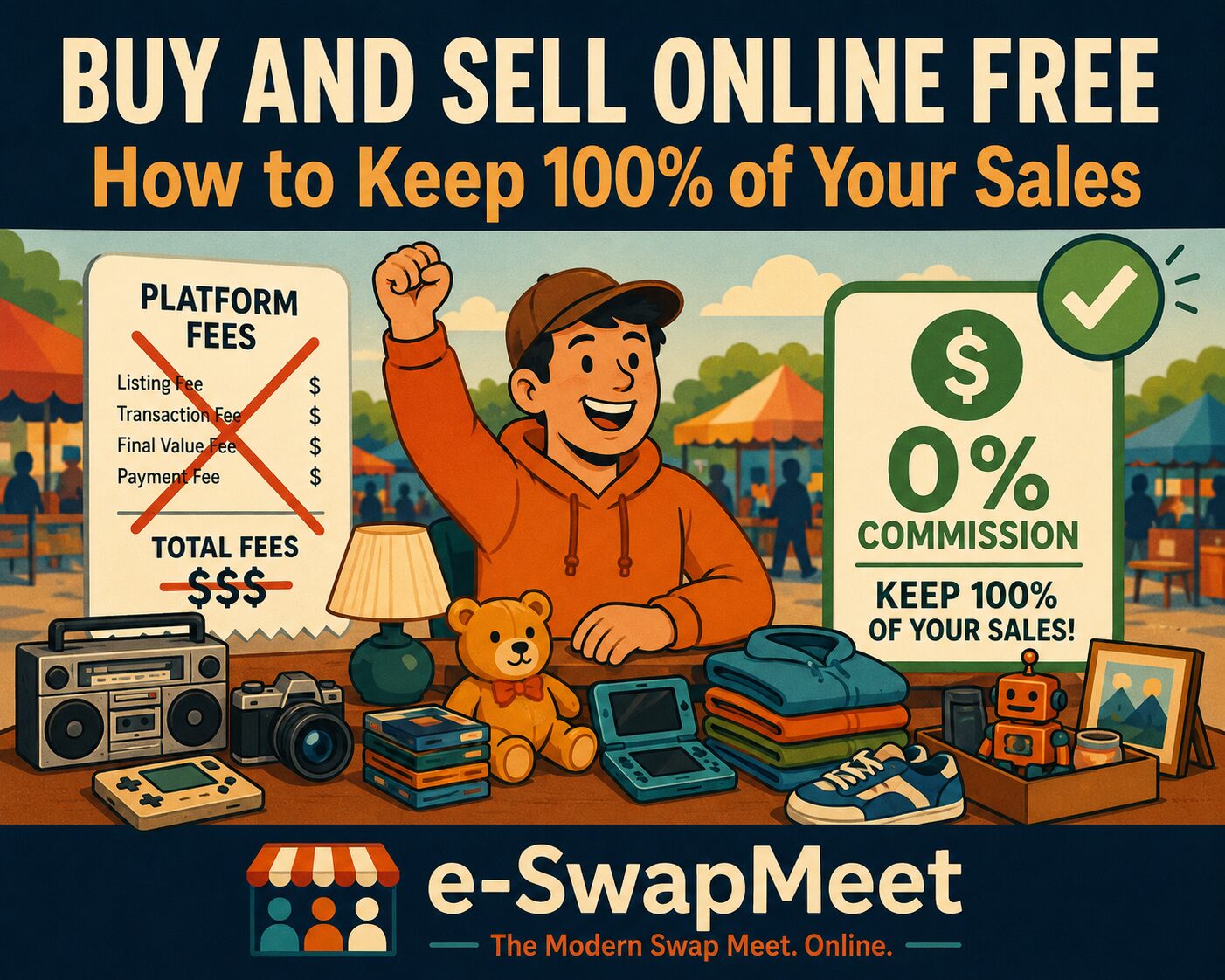
e-SwapMeet makes it possible to buy and sell online on a flat subscription model. Vendors pay $10 a month, flat. No commission. No per-sale cut from what you earn. No listing fees. Sell one item or five hundred items in a month, and your cost stays the same.
For someone moving $500 a month in product, that’s potentially $50-$75 in commission fees they’re not paying. For someone doing $2,000 a month, it’s $250 or more staying in their pocket every single month.
Who Actually Benefits From Paying Zero Commission
The no-commission model isn’t for everyone, and it’s worth being honest about that.
If you sell one or two items a month and never plan to scale, a commission-based platform with no upfront cost might make more sense. The math works in your favor at very low volume.
But if any of these describe you, the subscription model is worth a hard look:
Swap meet and flea market vendors who already have physical inventory and want to move product online without learning a new complicated system. You know how to sell. You just need a place to buy and sell online digitally.
Resellers who source from thrift stores, estate sales, liquidation pallets, or discount retailers. Margins are already thin in this game. Giving away 13% per sale kills the business model.
Dropshippers who run on volume and need predictable costs. When you’re processing dozens of orders a week, per-sale fees stack up in a way that’s hard to forecast and harder to absorb.
Side hustlers going full-time. The moment selling becomes your primary income, every fee matters. A flat monthly cost is easier to budget around than a variable percentage.
How e-SwapMeet Fits Into the Picture
e-SwapMeet was built specifically for the vendor who’s been selling at swap meets, flea markets, and garage sales and wants to take that hustle online without losing their margin to a corporate platform.
The marketplace is designed to feel familiar. Vendors get their own storefront, list their products, and set their own prices. Shoppers browse, buy, and checkout directly. The vendor gets paid. Nobody takes a cut of the sale.
Beyond the fee structure, there are a few things worth knowing:
Your products can appear on Google Shopping, automatically. e-SwapMeet syncs with Google Merchant Center, which means your listings have a shot at showing up when someone searches for exactly what you’re selling. That’s organic visibility most small sellers can’t access on their own.
The platform is built for real sellers, not just dropshippers. The Inventory Cards system was designed for vendors with physical inventory: a simple grid-based system for photographing and listing products without needing a full studio setup or a tech background.
Flat $10/month. No contracts. No percentage. No surprises.
The Real Cost Comparison
Let’s run the numbers on a seller doing $1,000 in sales per month.
| Platform | Monthly Fee | Commission | Total Cost |
|---|---|---|---|
| eBay | $0 | ~$133 (13.25%) | $133 |
| Amazon | $39.99 | ~$150 (15% avg) | ~$190 |
| Etsy | $0 | ~$65 (6.5%) | ~$65+ |
| e-SwapMeet | $10 | $0 | $10 |
At $1,000/month in sales, e-SwapMeet costs $10. eBay costs $133. That’s $123 in monthly savings, or $1,476 a year, that stays with the seller.
Scale that to $3,000/month and the gap grows to $390+ per month on eBay alone.
The math is not subtle.
How to Get Started Buying and Selling Online
Getting set up to buy and sell online on e-SwapMeet takes less than 10 minutes. Anyone can buy and sell online here without a steep learning curve.
- Create your vendor account at e-swapmeet.com
- Set up your storefront: add your store name, logo, and a short description
- List your first product: photos, price, description, done
- Start selling: your store is live and visible to shoppers immediately
There’s no approval process, no inventory minimum, and no required product count. List what you have, price it how you want, keep what you earn.
If you already buy and sell online somewhere else, such as eBay, Facebook, or Mercari, you don’t have to quit. Start with a few listings on e-SwapMeet and run the comparison yourself. The fee savings show up immediately.
The Bottom Line: How to Buy and Sell Online for Less
Commission fees are the cost of doing business on most platforms, but they don’t have to be. You can buy and sell online without handing over a percentage of every sale, and it’s not a gimmick or a workaround. It’s just a different business model that happens to favor the seller.
If you’re serious about selling online and serious about keeping your margin, it’s worth 10 minutes to set up a store and see what the numbers look like when you buy and sell online without a platform taking a cut.